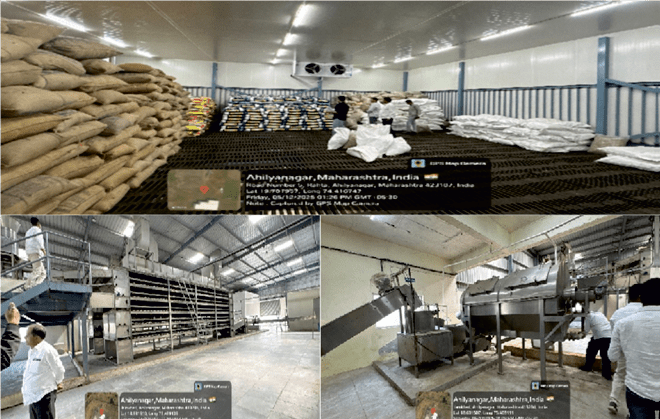
Access to modern post-harvest infrastructure and efficient market linkages has become essential for enhancing farmers’ incomes and reducing post-harvest losses. One inspiring example is Khemanand Dudh and Krishi Producer Company Limited, an enterprise based in Ahilyanagar, Maharashtra. The company has transformed the onion value chain by developing an integrated post-harvest processing and procurement network. Its journey highlights the transformative role of the Venture Capital Fund for Scheduled Castes (VCF-SC) under the Ministry of Social Justice and Empowerment.
Under the Pradhan Mantri Kisan SAMPADA Yojana (PMKSY) – Operation Greens Scheme, the company established an integrated onion value chain development project across five locations in Maharashtra. The project includes procurement, grading, sorting, packaging, cold storage, and an onion dehydration plant. It also received support from the Ministry of Food Processing Industries, Government of India.
Recognizing the project’s potential to strengthen agricultural infrastructure and improve farmers’ livelihoods, the Venture Capital Fund for Scheduled Castes (VCF-SC) provided financial assistance of ₹12 crore in 2023 through equity and Optionally Convertible Debentures (OCDs). This support enabled the company to strengthen its post-harvest processing infrastructure, expand its procurement capacity, and develop an efficient supply chain connecting farmers with organized markets.
The impact of this initiative has been remarkable. Today, the company has expanded its farmer network to nearly 8,000 farmers. It has generated direct and indirect employment opportunities, created productive rural assets, achieved an annual revenue of ₹25.51 crore, and strengthened its net worth to ₹30 crore.
The project has significantly improved grading, handling, and storage facilities, reduced post-harvest losses, enabled farmers to realize better prices for their produce, and established strong market linkages with institutional buyers and organized retail companies. As a result, it has created sustainable livelihood opportunities in rural areas.